
 |
The Proximal Femoral Locking Plate-I is a high-performance orthopedic implant engineered for the internal fixation of complex fractures in the proximal femur, including the greater trochanter, peritrochanteric region, and subtrochanteric shaft (AO/OTA Type 31). This region of the femur is subjected to intense biomechanical stresses during weight-bearing and movement. Constructed from medical-grade Titanium Alloy (Ti6Al4V ELI), the plate is anatomically pre-contoured to fit the lateral flare of the proximal femur, ensuring an optimal fit without the need for extensive intraoperative bending. The proximal head of the plate features multiple locking screw holes with specific trajectories that target the femoral neck and head, providing superior anchorage in the "safe zones" of the proximal femur. The TOOLMED Plate-I system utilizes Locking Technology to create a fixed-angle construct, which is essential for maintaining alignment in comminuted fractures or in patients with osteoporotic bone. By providing rigid stabilization of the lateral column, this plate facilitates early patient mobilization and supports the biological healing process of the hip region.
Locking Plate
TOOLMED
TA3
1 Pcs
5-15 Days
/
Product Description
The plate is precision-shaped to mirror the natural anatomy of the proximal femur's lateral flare, ensuring a low-profile fit that reduces tension on the iliotibial (IT) band and surrounding soft tissues.
The specialized proximal screw configuration provides a multi-axial "raft" of screws into the femoral neck. This fixed-angle stability is critical for preventing the femoral head from collapsing (varus collapse) during healing.
The shaft of the plate features combination holes that allow surgeons the flexibility to use cortical screws for compression or locking screws for rigid stabilization, depending on the fracture pattern.
Manufactured from Titanium Alloy to provide maximum fatigue strength. This is vital for the proximal femur, which must support multiple times the body's weight during the gait cycle.
Primary indication for complex fractures involving the greater and lesser trochanters where a nail may not be suitable.
Used to bridge and stabilize fractures that extend from the trochanter into the upper third of the femoral shaft.
Provides essential buttressing for the lateral wall of the femur, which is the structural foundation for hip stability.
Indicated for salvage procedures where previous nails or screws have failed and a high-strength plate construct is required.

| Product Name | Proximal Femoral Locking Plate-I |
| Material | TA3 |
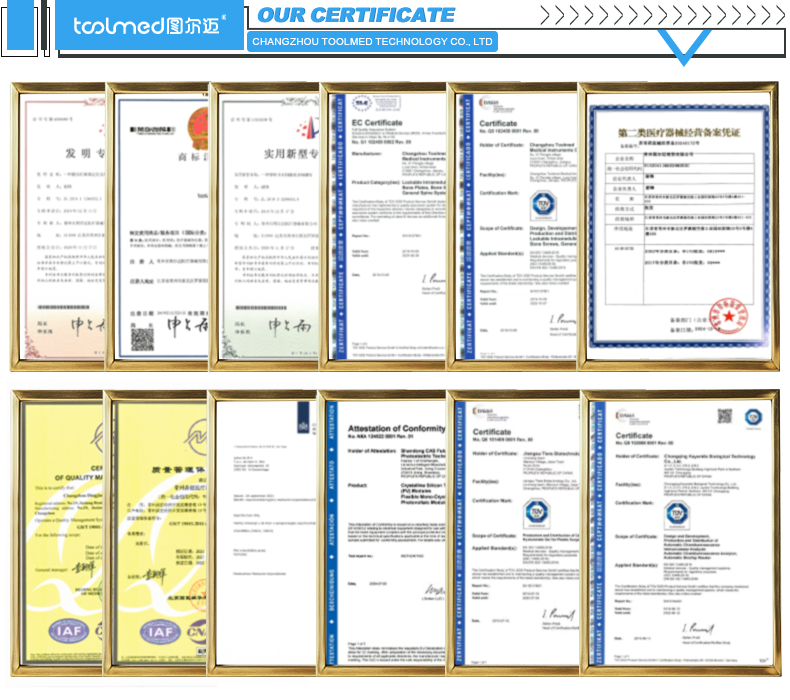
| Certificate | CE Certificate |
| Brand | TOOLMED |
| MOQ | 1 Pcs |
| OEM | Avaliable |
| Package | PE Inner Bag+Carton |
| Payment Method | T/T,Bank transfer, Western Union |
| Delivery Time | 5-15 Days |
| Shipping | DHL EMS UPS TNT FEDEX |


This is a high-strength titanium "internal brace" used to fix serious breaks at the top of the thigh bone, near the hip joint. The "proximal femur" is the part of the bone that includes the "ball" of the hip joint and the bony bumps you can feel on the side of your hip. Because this bone carries your entire body weight, a break here is very serious. This plate is shaped to fit the side of your bone perfectly, using locking screws to act like a solid frame that holds the pieces together so you can eventually walk again.
Surgeons use this plate in cases where the bone is broken into many pieces (comminuted) or when the bone is too soft for a simple screw. It is especially useful for "subtrochanteric" fractures—breaks that happen just below the hip joint. By securing the side of the bone, the plate prevents the hip from "sagging" or collapsing inward while the bone heals.
The main advantage is fixed-angle stability. In older surgeries, screws could sometimes "cut through" soft bone or loosen over time. With the TOOLMED locking system, the screws lock into the plate, creating a single rigid unit. This is much stronger and is essential for keeping the hip joint in the correct anatomical position during the 3 to 6 months it takes to heal.
Biomechanically, the proximal femur is like a crane. The "arm" of the crane is the femoral neck, and the "base" is the shaft. When you walk, gravity puts a massive "bending" force on this area. The Proximal Femoral Plate-I acts as a tension band on the outside of the bone, neutralizing these bending forces and allowing the fracture pieces to stay compressed together.
The surgeon makes an incision on the side of the thigh. Using X-ray guidance, the broken bones are carefully moved back into place. The plate is then positioned against the bone and secured with specialized screws that go into the femoral neck and down into the leg bone. Because it is pre-shaped, it fits the natural curve of the femur, making the surgery more efficient.
Because the femur is the largest bone in the body, recovery takes time. You will likely use a walker or crutches for several weeks to avoid putting full weight on the leg. However, because the plate is so strong, you can often begin moving your hip and knee in bed very soon after surgery, which is vital for preventing blood clots and joint stiffness.
The Proximal Femoral Locking Plate-I is a critical tool for restoring the structural foundation of the hip. Its combination of anatomical design and fixed-angle locking stability provides the security needed to rebuild the upper femur, giving patients the best possible chance at returning to an active, independent life.
Both plates and nails (intramedullary nails) are excellent. Your surgeon will choose a plate if the fracture pattern makes it difficult to insert a nail or if the "greater trochanter" (the side bone) needs extra support that only a plate can provide.
The plate is "low-profile," but because there is often only muscle and skin on the side of the hip, some thin patients might feel the edge of the plate. It is designed with smooth edges to minimize any irritation.
Yes. Titanium is the most "biocompatible" metal, meaning the body accepts it very well. It is also non-magnetic, so it is safe for MRI scans and will not set off most airport security scanners.
A typical proximal femur surgery takes between 1.5 to 3 hours, depending on how complex the fracture is. Your surgeon will use X-rays throughout the procedure to ensure the plate is in the perfect position.
Most patients start standing with the help of a therapist within a few days. However, "full" walking without crutches usually takes 3 to 4 months, once X-rays show the bone has fully bridged the gap.
We offer fast and reliable global shipping. Standard lead times range from 7 to 15 working days, depending on order quantity and customization requirements. Express delivery options are also available upon request.
Yes, we ship to most countries worldwide. We work with trusted logistics partners to ensure timely and secure delivery.
We accept a variety of payment options, including T/T (bank transfer), L/C, and PayPal for smaller orders. Payment terms can be discussed based on order volume and partnership agreements.
Yes, samples are available for evaluation. Please contact our sales team to request product samples and shipping arrangements.
Absolutely. We offer OEM/ODM services including custom packaging, branding, and product development tailored to your specifications.


