English


Views: 0 Author: Site Editor Publish Time: 2026-11-03 Origin: Site
The Krackow locking suture technique is a widely used method for tendon and ligament repair in orthopedic surgery. It provides strong tissue purchase through a series of locking loops placed along the longitudinal fibers of the tendon or ligament.
Unlike simple interrupted sutures, the Krackow technique distributes tensile forces across multiple locking loops, helping secure the tendon and reduce the risk of suture pullout. It is particularly useful for repairing ruptured tendons with poor-quality, frayed, or longitudinally split tissue.
The technique is commonly applied in Achilles tendon repair, patellar tendon repair, quadriceps tendon repair, and selected ligament and capsular repairs.
Understanding its development, mechanical advantages, clinical indications, and correct suture placement is essential for achieving reliable soft tissue fixation.
The Krackow locking suture technique was first reported by Krackow and colleagues in 1986. It was developed to provide secure fixation of ligamentous and capsular tissues in orthopedic procedures.
Krackow was a knee surgeon whose research interests included prosthetic and instrument design in total knee arthroplasty. He later published The Technique of Total Knee Arthroplasty in 1990.
During total knee arthroplasty, correction of valgus deformity may require the medial joint capsule, ligamentous structures, and periosteal sleeve to be advanced distally and securely fixed.
This creates an important technical challenge: how can these soft tissue structures be grasped as a continuous unit and maintained under tension without producing the purse-string effect associated with some conventional suture configurations, such as the Bunnell technique?
After repeated experimentation, Krackow developed a locking-loop suture configuration designed to provide secure tissue purchase along the longitudinal fibers.
Experimental work by Krackow and colleagues suggested that the locking-loop configuration could provide strong fixation without significantly compromising the circulation of the repaired tissue under the studied conditions.
More recently, quantitative magnetic resonance imaging research by Page and colleagues has also investigated tissue perfusion following locking suture techniques. Such findings are relevant to understanding the biological effects of tendon fixation, although perfusion outcomes should be interpreted in the context of the specific study design and tissue conditions.
The Krackow technique offers several mechanical and practical advantages for tendon and ligament repair.
The main advantage is its ability to obtain secure purchase along longitudinal tendon fibers.
Multiple locking loops engage the tendon tissue and distribute tensile forces over a longer segment rather than concentrating the load at a single point.
This is particularly useful when the tendon ends are frayed, elongated, or have a brush-like appearance after rupture.
The locking configuration helps prevent the suture from slipping through the tendon fibers under tension.
Compared with a simple non-locking stitch, multiple locking loops can improve the mechanical grip on the tissue.
However, the ultimate strength of tendon repair also depends on tendon quality, suture material, loop configuration, number of strands, knot security, and surgical technique.
The Krackow technique is designed to engage longitudinal tendon fibers without excessively splitting or separating the fiber bundles.
This helps reduce the risk of the suture cutting through the tendon or pulling out of the tissue.
The locking loops provide a distributed grasp, which is particularly valuable in damaged or fragmented tendon tissue.
The technique is especially useful for broad or relatively flat soft tissue structures, where a longitudinal locking pattern can capture multiple fiber bundles.
It can be used in tendon, ligament, and joint capsule repair when the tissue configuration and surgical objective are appropriate.
The Krackow locking suture is used in several orthopedic procedures involving tendon and ligament repair.
Typical applications include:
Quadriceps tendon rupture repair.
Patellar tendon rupture repair.
Achilles tendon rupture repair.
Selected collateral ligament repairs.
Joint capsule and periosteal sleeve fixation.
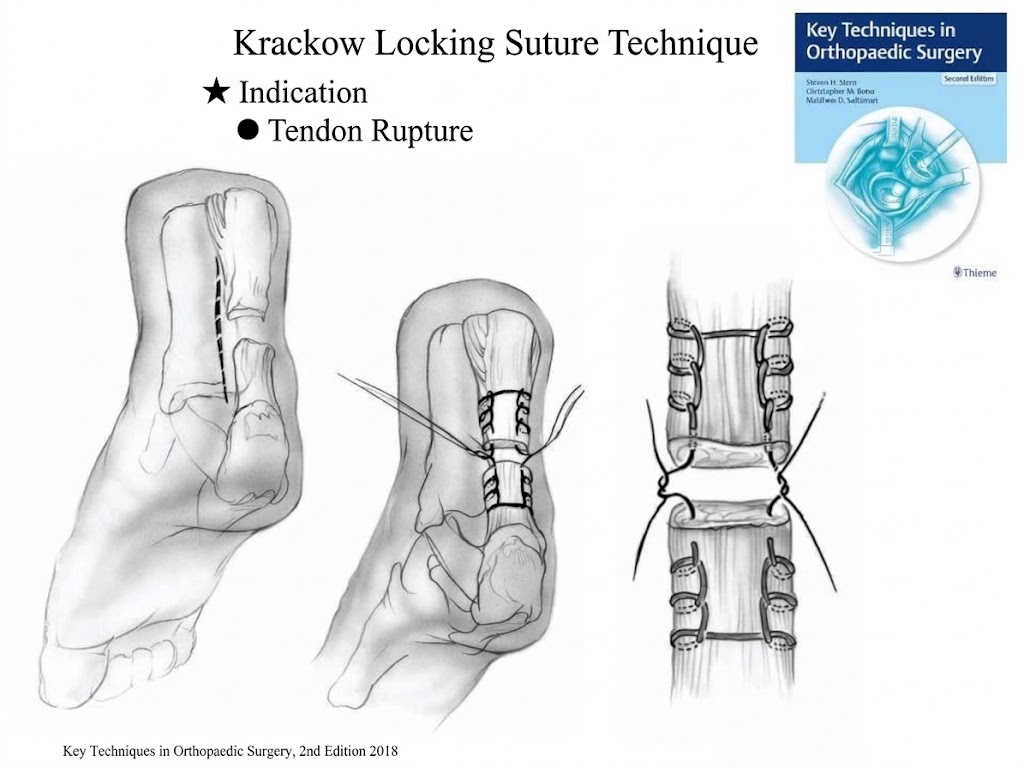
Achilles tendon rupture is one of the most common clinical applications of the Krackow technique.
The Achilles tendon is subjected to substantial tensile loading during walking, running, jumping, and other activities. Reliable tendon approximation and fixation are therefore important during surgical repair.
The Krackow locking suture is frequently used to secure the proximal and distal tendon ends, particularly in acute ruptures where adequate tendon tissue is available for suture purchase.
A limited-incision approach using a medial incision of approximately 1.5 cm has also been described for selected acute Achilles tendon ruptures.
The choice between open, mini-open, and minimally invasive repair depends on rupture characteristics, tendon quality, surgeon experience, and the risk of complications such as sural nerve injury and wound problems.
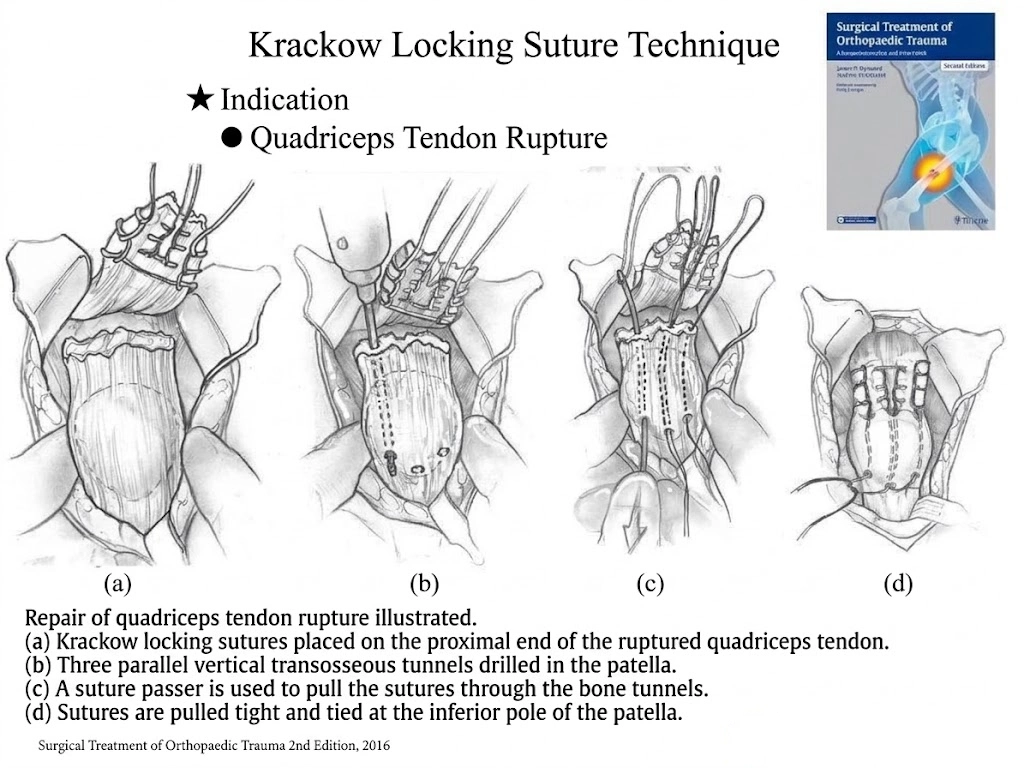
Quadriceps tendon rupture can result in loss of active knee extension and significant functional impairment.
The Krackow technique can be used to place strong locking sutures in the tendon, allowing the surgeon to secure the tendon to its attachment site.
In many repair techniques, the suture strands are passed through patellar bone tunnels or secured using appropriate suture anchors, depending on the chosen reconstruction method.
The goal is to restore tendon continuity and maintain secure fixation during the early healing period.
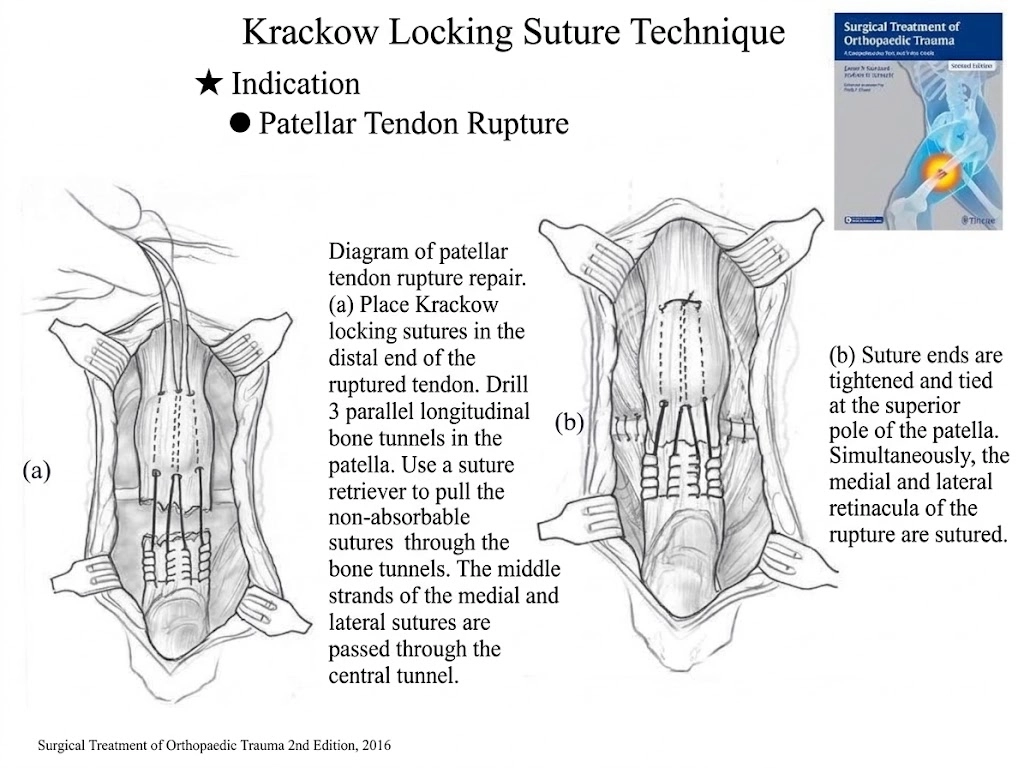
Patellar tendon rupture disrupts the extensor mechanism of the knee and can significantly impair active knee extension.
The Krackow locking suture is commonly used to reinforce the tendon ends and provide secure tissue purchase.
For selected repairs, the sutures may be passed through bone tunnels in the patella or attached using suture anchors.
The technique is also described in the surgical treatment of selected inferior pole patellar fractures, where the patellar tendon and extensor mechanism require secure reattachment or reinforcement.
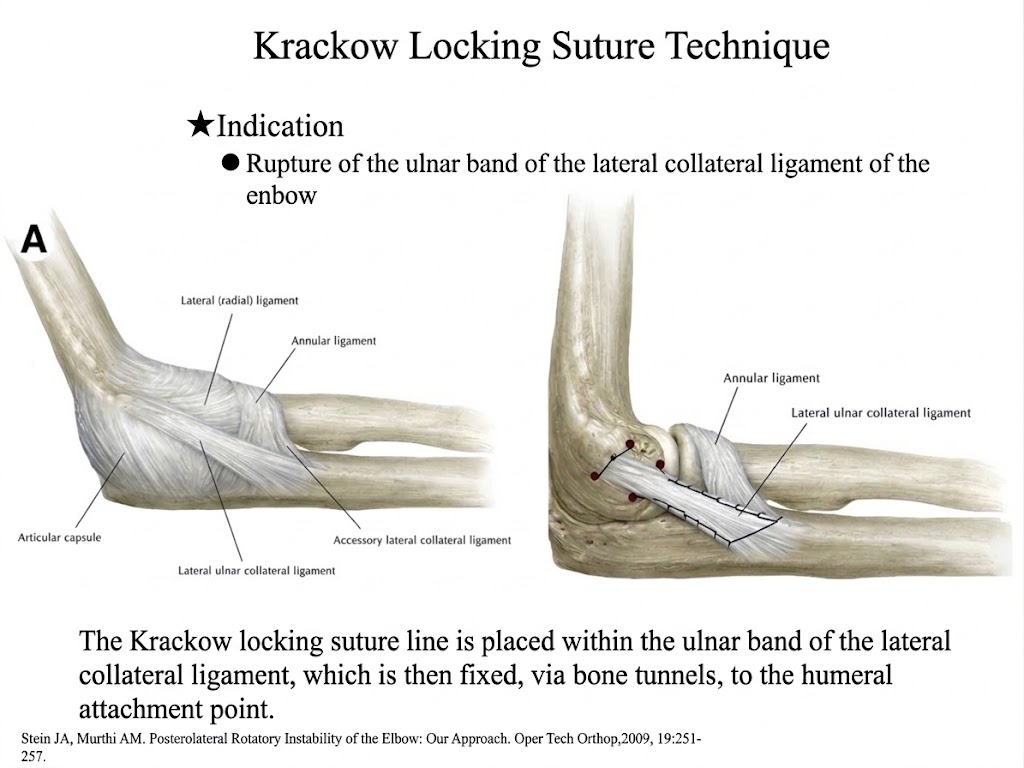
The Krackow technique can also be applied to selected ligament and capsular injuries.
One example is repair of the ulnar bundle of the lateral collateral ligament complex of the elbow, when the tissue configuration and surgical approach permit a locking-loop repair.
Its ability to capture longitudinal fibers makes it useful for selected soft tissue structures that require secure fixation under tension.
The Krackow technique uses a continuous series of locking loops along the longitudinal axis of the tendon.
The main objective is to obtain secure tissue purchase while distributing tension across multiple loops.
Expose the ruptured tendon and assess the quality of the remaining tissue.
Remove only clearly nonviable tissue when necessary, while preserving as much healthy tendon as possible.
Identify the longitudinal fiber direction and select a suitable region for suture placement.
Pass the suture through the tendon near the selected starting point.
Create the first locking loop according to the intended direction of the suture path.
The loop should engage the tendon fibers securely without placing the stitch too close to the tendon edge.
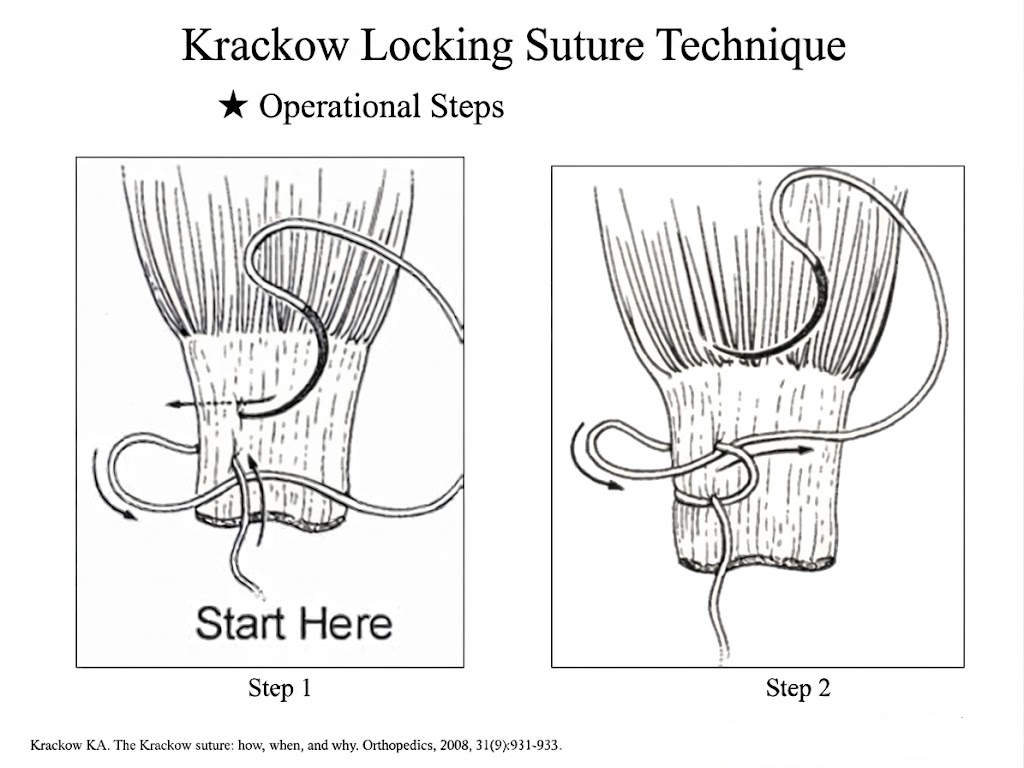
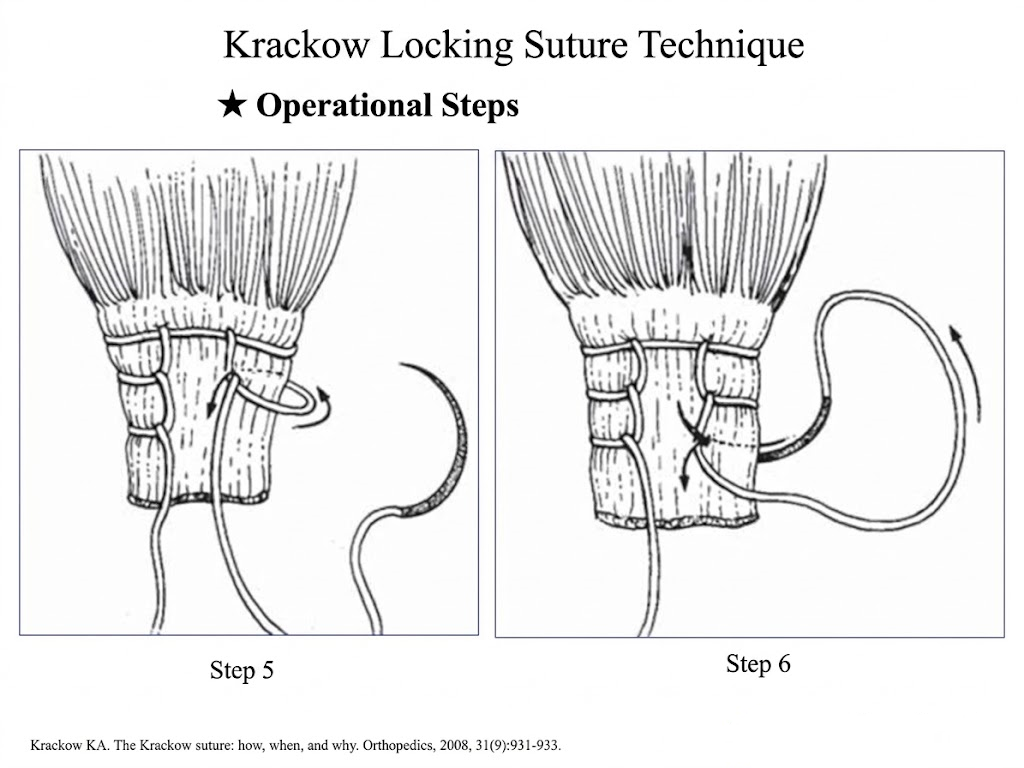
Continue the suture along the longitudinal axis of the tendon, creating successive locking loops.
Each loop should capture an adequate amount of tendon tissue.
Maintain consistent spacing and avoid excessive tension that could damage or strangulate the tissue.
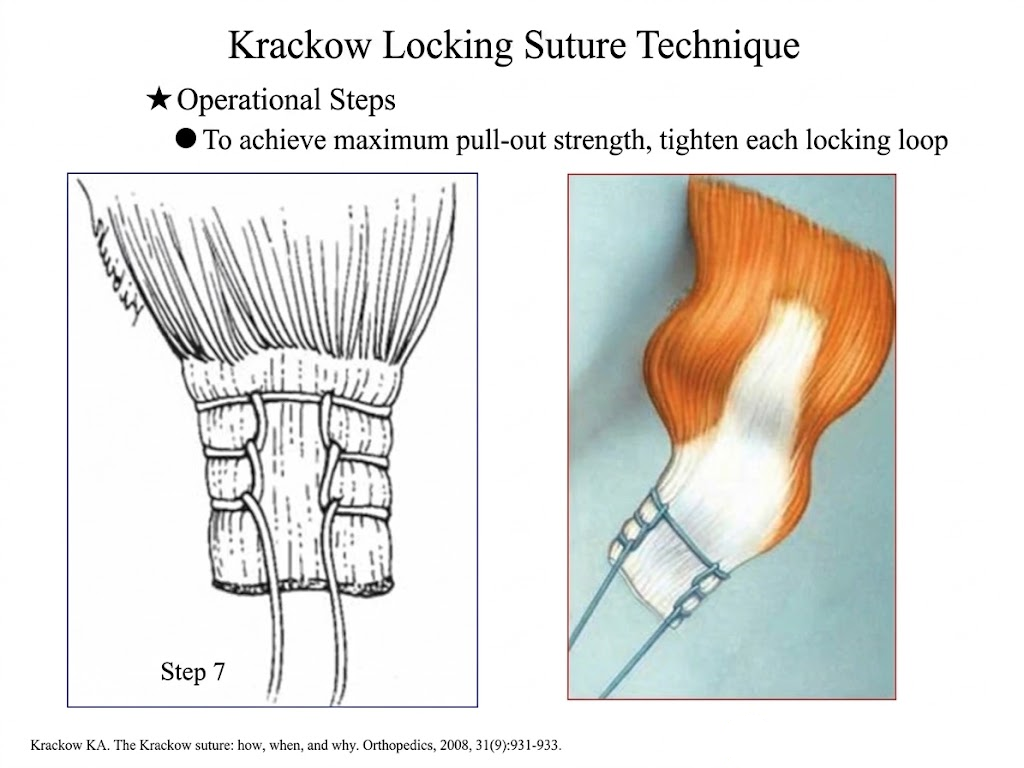
Tighten each locking loop individually as the suture pattern progresses.
This is important for achieving firm tissue engagement and maximizing resistance to suture pullout.
Loose loops may reduce the effectiveness of the locking configuration.
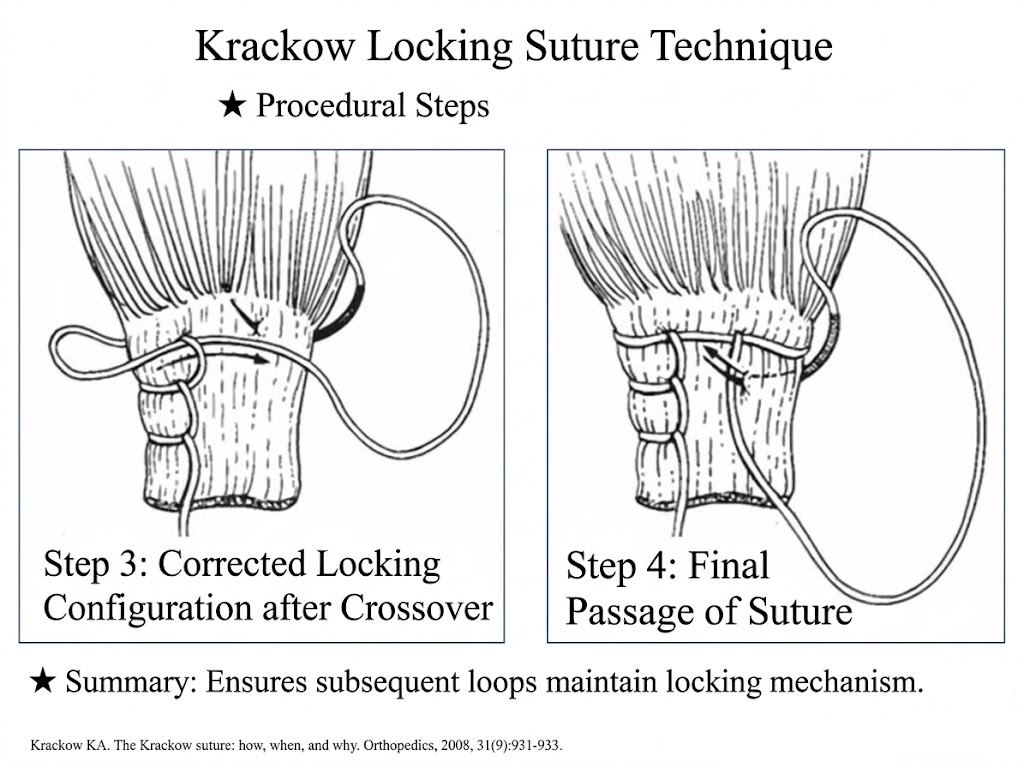
After completing the locking loops along the selected tendon segment, bring the suture ends together according to the planned repair configuration.
The number of loops should be selected according to tendon dimensions, tissue quality, and the intended fixation method.
After completing the first Krackow locking suture, a second suture can be added when additional fixation strength or tissue control is required.
The second suture may be positioned:
Inside the first suture pattern.
Above the first suture pattern.
Alongside the first suture pattern.
The final arrangement depends on tendon width, tissue quality, and the required repair configuration.
Krackow recommended three locking loops in one direction as a practical configuration.
In this approach:
Two loops may provide insufficient tissue purchase in some situations.
Three loops provide a balanced configuration for capturing the tendon fibers.
Four loops may be unnecessary when three loops already provide adequate fixation.
The first loop is particularly important because it is closest to the free edge of the ruptured tendon. If this loop cuts through the tissue, the overall fixation strength may be reduced.
For this reason, three loops are commonly described as a practical and secure configuration in the original technique.
Nevertheless, three loops should not be treated as a universal rule for every tendon repair. The appropriate number and spacing depend on the tendon dimensions, tissue quality, suture size, and surgical construct.
Although the Krackow technique is relatively straightforward to learn, several technical details influence the quality of the repair.
The first locking loop is exposed to significant stress because it is located near the free tendon edge.
If it is placed too close to the edge, the suture may cut through the tendon under tension.
Adequate tissue capture and appropriate spacing are essential.
Uneven loop spacing can result in uneven force distribution.
The surgeon should maintain a consistent pattern while adapting the spacing to the tendon dimensions and tissue quality.
Each locking loop should be tightened sufficiently to engage the tendon fibers.
However, excessive tightening may compress or damage the tissue.
The goal is secure fixation without unnecessary tissue strangulation.
Frayed, degenerated, or thin tendon tissue may require a modified repair strategy or additional reinforcement.
The Krackow technique should be selected as part of the overall repair construct rather than considered a substitute for appropriate tissue assessment and fixation planning.
After completing the suture pattern, the tendon ends should be approximated without excessive tension.
The repair should restore appropriate tendon continuity and the functional length of the involved structure.
In Achilles tendon repair, for example, restoration of tendon length and tension is particularly important for postoperative function.
The Krackow technique is a locking-loop suture method used to secure tendon and ligament tissue. It involves placing multiple interlocking loops along the longitudinal fibers to improve tissue purchase and resistance to suture pullout.
It is commonly used for Achilles tendon repair, quadriceps tendon repair, and patellar tendon repair. It can also be used in selected ligament and joint capsule repairs.
The technique provides strong tissue purchase along the tendon fibers and helps distribute tensile forces across multiple locking loops. This makes it useful for securing the tendon ends during Achilles tendon repair.
Three locking loops in one direction are a commonly described configuration in the original technique. However, the final number depends on tendon size, tissue quality, suture material, and the overall repair construct.
Both techniques are used to secure tendon tissue, but their stitch paths and tissue engagement patterns differ. The Krackow technique uses a series of locking loops along the longitudinal tendon fibers, while the Bunnell technique uses an interlocking pattern that crosses the tendon fibers. The choice depends on the tissue anatomy, repair objective, and surgeon preference.
The Krackow locking suture is an established and versatile technique in orthopedic tendon and ligament repair.
Its main advantages include strong tissue purchase, distributed tensile loading, and resistance to suture pullout. These characteristics make it particularly useful for repairing frayed or disrupted tendon tissue.
Common applications include Achilles tendon repair, quadriceps tendon repair, patellar tendon repair, and selected ligament and capsular procedures.
Successful application requires careful tendon assessment, appropriate loop spacing, secure tightening, and restoration of the correct tendon tension and length.
By understanding the principles and technical details of the Krackow locking suture, orthopedic surgeons can select and apply this technique more effectively as part of an appropriate soft tissue repair strategy.


