
Views: 0 Author: Site Editor Publish Time: 2026-11-13 Origin: Site
An anterior cruciate ligament (ACL) tear is one of the most common serious knee injuries, particularly among athletes and individuals participating in sports that involve sudden changes of direction, jumping, landing, and pivoting movements.
The ACL is an important ligament inside the knee joint. It helps control forward movement and rotational stability of the tibia relative to the femur. When the ligament is torn, patients may experience a sudden popping sensation, severe pain, rapid swelling, and a feeling that the knee is giving way.
Treatment options depend on the severity of the injury, the patient's activity level, knee stability, and the presence of associated injuries such as meniscal tears.
For patients with persistent knee instability or high functional demands, ACL reconstruction surgery may be recommended. The procedure typically uses a tendon graft to replace the torn ligament and restore knee stability.
This article explains the symptoms and causes of ACL injuries, non-surgical treatment options, ACL reconstruction techniques, graft selection, associated meniscus injuries, and postoperative recovery.
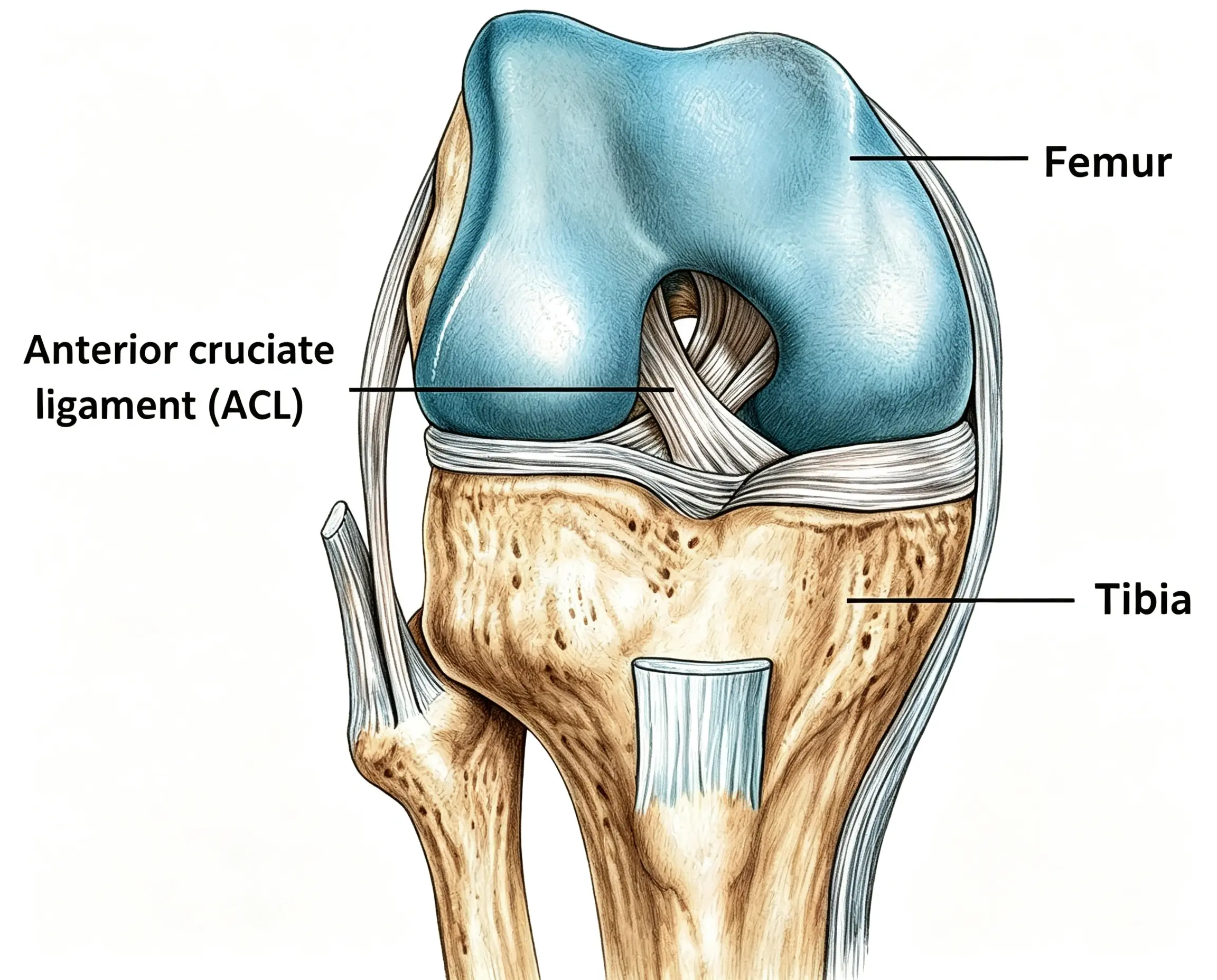
The anterior cruciate ligament (ACL) is a strong band of connective tissue located inside the knee joint. It connects the femur (thighbone) to the tibia (shinbone) and plays a major role in maintaining knee stability.
Its main functions include:
Preventing excessive anterior translation of the tibia relative to the femur.
Controlling rotational movement of the knee.
Contributing to knee stability during pivoting, twisting, and sudden directional changes.
Supporting coordinated movement during walking, running, jumping, and sports activities.
The ACL works together with other knee structures, including the posterior cruciate ligament (PCL), collateral ligaments, menisci, and surrounding muscles.
When the ACL is torn, the knee may lose part of its ability to control forward and rotational movement, potentially leading to recurrent instability during demanding activities.
ACL injury symptoms can vary depending on the severity of the tear and whether other knee structures are damaged.
Common symptoms include:
Many patients report hearing or feeling a distinct "pop" at the moment of injury.
Although this is a common symptom of ACL tears, it is not specific to ACL injuries and may also occur with other knee injuries.
Acute pain often develops immediately after the injury.
The severity may prevent the patient from continuing sports activities or bearing weight comfortably.
Swelling may develop within the first few hours after injury.
Rapid swelling can be associated with bleeding inside the knee joint (hemarthrosis), which commonly occurs with acute ACL injuries.
Pain and swelling may make it difficult to fully bend or straighten the knee.
Some patients also experience stiffness or difficulty walking.
A characteristic symptom of ACL deficiency is a feeling that the knee is giving way, particularly during:
Sudden changes of direction.
Pivoting movements.
Running and deceleration.
Jumping and landing.
Walking on uneven surfaces.
Persistent instability may interfere with sports participation and daily activities.
An ACL tear occurs when the ligament is stretched beyond its normal capacity or subjected to excessive rotational and mechanical forces.
ACL injuries are common in sports that require sudden acceleration, deceleration, jumping, landing, and directional changes.
Common causes include:
Rapidly slowing down while running can place substantial stress on the ACL, especially when combined with poor movement control or knee rotation.
Pivoting or cutting movements are common mechanisms of non-contact ACL injuries.
These movements can create excessive rotational forces across the knee joint.
Landing awkwardly after a jump may increase ACL loading, particularly when the knee moves into an unfavorable position under high force.
This mechanism is frequently seen in basketball, volleyball, gymnastics, and other jumping sports.
Direct impact to the knee during contact sports, such as football and rugby, may also cause ACL tears.
Depending on the direction and magnitude of the force, other ligaments and meniscal structures may be injured at the same time.
Sports with frequent pivoting, jumping, and sudden directional changes include:
Soccer.
Basketball.
Rugby.
American football.
Volleyball.
Skiing.
Handball.
Both contact and non-contact mechanisms can result in ACL injuries.
Not every ACL tear requires surgery.
Non-surgical treatment may be appropriate for selected patients, particularly those with lower activity demands, relatively stable knees, or injuries that do not cause recurrent functional instability.
The primary goals are to reduce pain and swelling, restore knee motion, strengthen supporting muscles, and improve neuromuscular control.
Initial treatment may include the RICE approach:
Rest: Temporarily reduce activities that aggravate knee pain.
Ice: Apply cold therapy to help manage pain and swelling.
Compression: Use an appropriate compression bandage or support when suitable.
Elevation: Elevate the affected leg to help reduce swelling.
These measures are intended for early symptom management and do not repair the torn ACL.
A knee brace may be recommended in selected cases to provide support and improve confidence during daily activities.
The type and duration of brace use depend on the injury pattern, symptoms, and rehabilitation plan.
A brace does not restore the mechanical function of a completely torn ACL.
Structured rehabilitation is an essential part of both non-surgical and surgical ACL treatment.
A physical therapy program may focus on:
Reducing swelling.
Restoring full knee extension and functional flexion.
Strengthening the quadriceps and hamstring muscles.
Improving balance and proprioception.
Developing neuromuscular control.
Gradually restoring walking and functional movement.
Some patients can achieve satisfactory functional stability through rehabilitation without ACL reconstruction.
However, patients who continue to experience recurrent instability may be at risk of additional injuries to the meniscus and articular cartilage.
ACL reconstruction may be considered when the torn ligament causes persistent functional instability or when the patient's activity requirements make knee stability particularly important.
Surgery is commonly discussed in situations such as:
Recurrent episodes of knee giving way.
Persistent instability despite structured rehabilitation.
Participation in sports involving pivoting, cutting, and sudden directional changes.
High physical demands at work or during daily activities.
Combined injuries involving the meniscus or other knee structures.
Selected acute ACL injuries in young and physically active patients.
The decision should not be based on age alone or on MRI findings alone.
Instead, the orthopedic surgeon considers knee stability, activity goals, associated injuries, rehabilitation potential, and the patient's expectations.
For patients with significant swelling and restricted knee motion, a period of preoperative rehabilitation may be recommended before reconstruction to improve knee mobility and reduce the risk of postoperative stiffness.
ACL reconstruction is a surgical procedure designed to restore knee stability by replacing the torn ligament with a tendon graft.
Unlike a simple repair of the torn ligament, reconstruction typically uses a new graft to recreate the functional role of the ACL.
The procedure is commonly performed using arthroscopic techniques, which involve a small camera and specialized instruments inserted through small incisions around the knee.
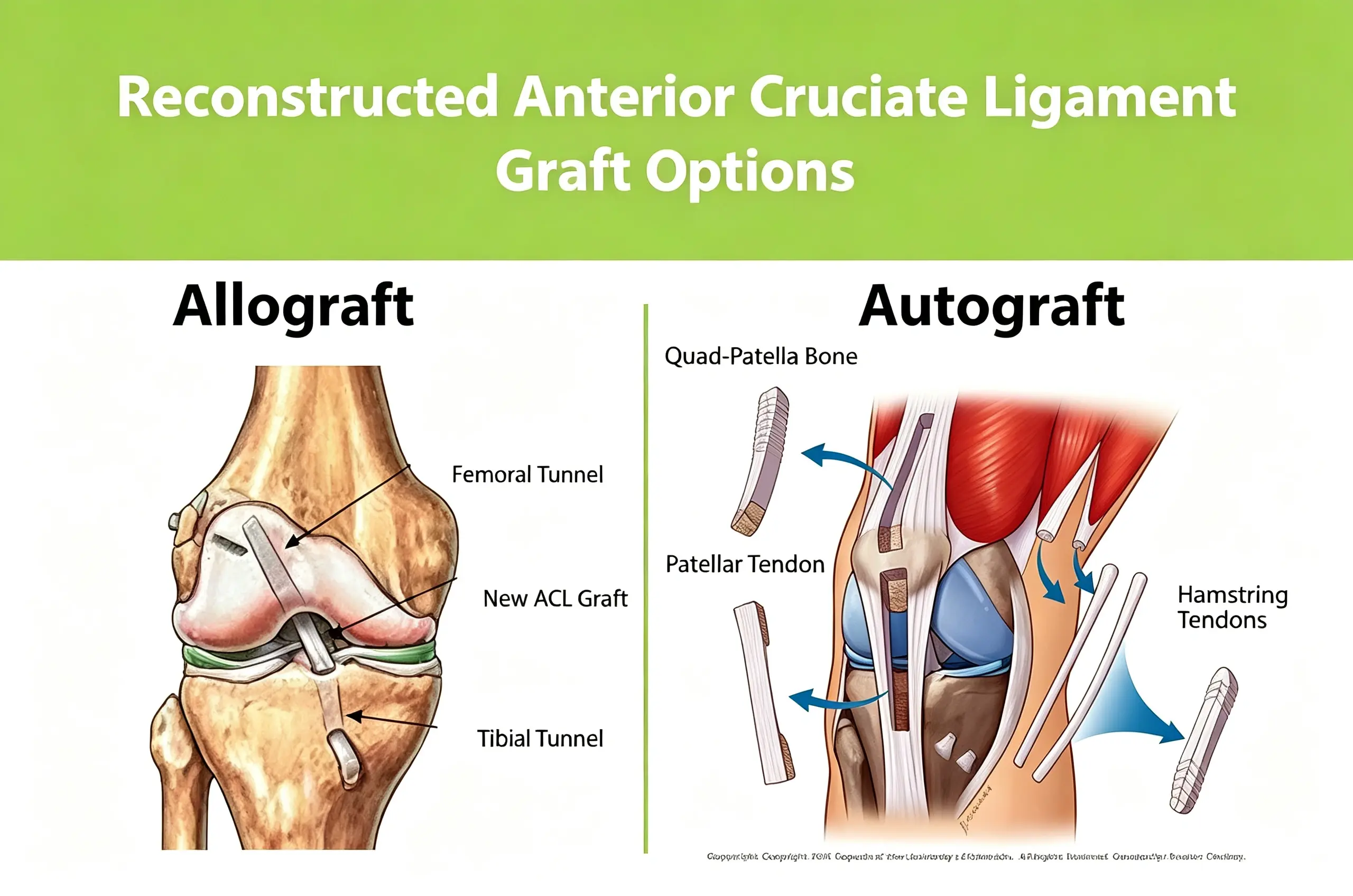
The graft is usually obtained from either:
The patient's own tendon tissue (autograft).
Donor tendon tissue (allograft).
The choice of graft depends on several factors, including:
Patient age.
Activity level and sports requirements.
Graft availability.
Previous knee surgery.
Associated injuries.
Potential donor-site complications.
Surgeon experience and preference.
Graft selection is one of the most important considerations in ACL reconstruction.
Different graft types have different advantages, limitations, and potential complications.
The bone-patellar tendon-bone (BPTB) graft is harvested from the patient's own patellar tendon.
The graft typically includes:
A central portion of the patellar tendon.
A bone plug from the patella.
A bone plug from the tibial tuberosity.
The graft is then prepared for implantation and secured within the femoral and tibial tunnels.
Advantages:
Strong fixation characteristics.
Bone-to-bone healing at the tunnel sites.
Well-established clinical outcomes.
Commonly considered for young and physically active patients.
Potential limitations:
Anterior knee pain.
Pain during kneeling.
Patellar tendon-related symptoms.
Rare complications involving the patella or extensor mechanism.
BPTB autografts are frequently considered for patients participating in high-demand sports, although graft selection should remain individualized.
A hamstring tendon graft is harvested from the patient's own hamstring tendons, commonly the semitendinosus tendon, with or without the gracilis tendon.
The harvested tendon is prepared and folded into a graft construct suitable for ACL reconstruction.
Advantages:
Avoids harvesting the central patellar tendon.
Generally associated with less anterior knee and kneeling pain than BPTB grafts.
Provides an alternative autograft option for many patients.
Potential limitations:
Possible hamstring weakness.
Donor-site discomfort.
Graft diameter variability.
Potential differences in graft healing and failure risk depending on patient characteristics.
Hamstring tendon autografts are widely used in ACL reconstruction, particularly when avoiding patellar tendon harvest is a priority.
An allograft uses tendon tissue obtained from a human donor.
Depending on availability and the surgical protocol, different donor tendons may be used.
Advantages:
No tendon harvesting from the patient's own knee.
Reduced donor-site morbidity.
Potentially shorter graft preparation time.
Useful in selected revision procedures and certain complex injuries.
Potential limitations:
Graft incorporation and remodeling may take time.
Potential differences in graft failure risk.
Processing methods may influence graft characteristics.
Disease transmission risk is extremely low with regulated tissue screening and processing but is not entirely absent.
Allografts may be considered for selected older or lower-demand patients, revision procedures, or situations where autograft harvesting is less desirable.
However, allograft use in young, highly active patients requires careful consideration because some studies have reported higher failure rates compared with autografts in these populations.
Yes. ACL tears frequently occur together with meniscal injuries, and both conditions can often be treated during the same surgical procedure.
The menisci are two crescent-shaped fibrocartilage structures located between the femur and tibia.
They play several important roles:
Distributing load across the knee joint.
Absorbing impact.
Improving joint congruity.
Contributing to knee stability.
Protecting the articular cartilage.
A twisting injury that tears the ACL may also damage the medial or lateral meniscus.
Combined injuries may occur during:
Sudden changes of direction, such as soccer and basketball.
Jumping and awkward landing, such as volleyball and gymnastics.
Direct knee trauma during skiing or accidents.
Contact injuries in rugby, football, and martial arts.
The combination of rotational forces and sudden knee displacement can damage both ligamentous and meniscal structures.
Diagnosis usually involves a combination of physical examination and imaging.
Clinical Examination
The orthopedic surgeon may perform:
Lachman test.
Anterior drawer test.
Pivot-shift test.
Joint-line tenderness assessment.
Meniscal provocative tests when appropriate.
These examinations help assess ACL integrity and identify possible meniscal involvement.
Magnetic Resonance Imaging (MRI)
MRI is commonly used to evaluate:
ACL disruption.
Medial and lateral meniscal tears.
Associated cartilage injuries.
Bone bruising.
Other ligament injuries.
Arthroscopy can provide direct visualization of intra-articular structures during surgery and may be used to assess and treat confirmed injuries.
When both ACL and meniscus injuries require surgery, they can often be treated during the same operation.
Treatment depends on the type, location, and severity of the meniscal tear.
Meniscus Repair
Meniscus repair is generally preferred when the tear pattern, location, and tissue quality make healing possible.
Repair techniques aim to preserve meniscal tissue and maintain its protective function.
Partial Meniscectomy
If a tear is not repairable, the surgeon may remove the unstable damaged portion while preserving as much healthy meniscal tissue as possible.
The choice between repair and partial meniscectomy should consider tear morphology, vascular zone, tissue quality, and patient-specific factors.
When an ACL reconstruction is performed together with meniscus repair, postoperative rehabilitation may require additional restrictions on weight-bearing and knee flexion.
Some pain and swelling are expected after ACL reconstruction.
Appropriate postoperative pain management is important because it allows patients to participate more comfortably in rehabilitation and helps restore knee movement.
A postoperative pain management plan may include:
Pain-relieving medications may be prescribed according to the patient's medical history and surgical protocol.
These may include selected analgesics and anti-inflammatory medications when appropriate.
Medication use should follow the treating clinician's instructions.
Applying cold therapy around the knee may help reduce postoperative pain and swelling.
Cold therapy should be used according to the recommended duration and skin-protection instructions to avoid cold-related skin injury.
Elevating the leg and using an appropriate compression system may help manage postoperative swelling.
Patients should follow their surgeon's instructions regarding compression, brace use, and wound care.
Early rehabilitation is an important part of postoperative recovery.
Depending on the surgical procedure and associated injuries, rehabilitation may include:
Regaining full knee extension.
Gradually restoring knee flexion.
Activating the quadriceps.
Improving patellar mobility.
Progressively restoring weight-bearing.
Developing balance and movement control.
The rehabilitation program must be adjusted when meniscus repair or other associated procedures are performed.
Recovery after ACL reconstruction is a gradual process that requires consistent rehabilitation.
The exact timeline varies according to graft type, surgical technique, associated injuries, and individual recovery.
Common rehabilitation goals include:
Early Phase: Pain and Swelling Control
The initial stage focuses on managing swelling, restoring knee extension, improving quadriceps activation, and protecting the graft.
Intermediate Phase: Strength and Mobility
As recovery progresses, rehabilitation emphasizes improved range of motion, muscle strength, balance, and neuromuscular control.
Advanced Phase: Functional Training
Later rehabilitation may include running progression, agility training, jumping exercises, and sport-specific movement drills when appropriate.
Return to Sports
Return to pivoting sports should not be based on time alone.
It generally requires adequate strength, functional performance, movement quality, psychological readiness, and clinical assessment.
Many athletes require approximately 9–12 months or longer before returning to high-demand pivoting sports, depending on their progress and the treating team's criteria.
Common symptoms include a popping sensation at the time of injury, rapid knee swelling, pain, reduced range of motion, and a feeling of instability or giving way.
Some patients can manage an ACL tear without surgery through structured rehabilitation, particularly if their activity demands are lower and the knee remains functionally stable.
However, patients with recurrent instability may require reconstruction to restore functional knee stability.
There is no single best graft for every patient.
BPTB, hamstring tendon, and allograft options each have advantages and limitations. Graft selection depends on age, activity level, sports requirements, donor-site considerations, and potential failure risks.
Yes. ACL reconstruction and meniscus treatment are commonly performed during the same operation when both injuries require surgical management.
The meniscus may be repaired or partially resected depending on the tear pattern and tissue quality.
Basic daily activities may resume progressively during the early recovery period, but complete rehabilitation takes much longer.
Many patients require several months of rehabilitation, and return to high-demand pivoting sports often takes approximately 9–12 months or longer.
Most ACL reconstructions are performed arthroscopically through small incisions using a camera and specialized instruments. However, graft harvesting may require additional incisions depending on the selected graft.
Many patients achieve substantial improvements in knee stability and function after reconstruction.
However, recovery outcomes vary. Some patients may continue to experience weakness, stiffness, or other symptoms, and ACL reconstruction does not completely eliminate the long-term risk of osteoarthritis.
An anterior cruciate ligament tear can significantly affect knee stability, physical activity, and quality of life.
Treatment options range from structured rehabilitation and activity modification to arthroscopic ACL reconstruction. For patients with persistent instability or high functional demands, reconstruction using an appropriate tendon graft may help restore knee stability.
Graft selection is an important part of surgical planning, with BPTB autografts, hamstring tendon autografts, and allografts each offering different advantages and limitations.
When ACL and meniscus injuries occur together, both conditions can often be addressed during the same surgical procedure. Preserving meniscal tissue whenever feasible is an important consideration for long-term knee health.
Ultimately, successful ACL treatment depends on accurate diagnosis, individualized surgical planning, appropriate graft selection, and a structured rehabilitation program.
This article is intended for medical education and professional reference. Treatment decisions should be made by qualified orthopedic professionals based on individual clinical assessment.


